
17th September, 2026
Drum handling for honey producers: how Grab-O-Matic keeps the UK’s honey industry moving

From New Zealand to Newtown – raw honey arrives in bulk 200-litre drums, and moving them safely requires equipment built for the job
By Andy Bow, Managing Director, St Clare Engineering
Most people think of honey as something that comes in a jar. For the companies that produce it, honey arrives as something quite different: hundreds of solid, crystallised drums weighing close to 450 kilograms each, shipped from apiaries across the world and stacked in receiving bays waiting to be processed.
St Clare Engineering supplies drum handling forklift attachments to honey producers across the UK and internationally, including Rowse Honey, Hilltop Honey and Littleover Apiaries. This article explains what makes honey handling one of the more demanding drum handling applications in the food industry – and why the quality of the attachment matters more than many buyers expect.
How raw honey reaches UK producers
The honey on British supermarket shelves begins its journey in apiaries on multiple continents. Producers source raw honey from New Zealand, South America, Eastern Europe, Argentina, Ukraine and beyond. It is harvested, filtered to remove wax and debris, and packed into standard 200-litre steel drums for shipping.
At this stage, the honey is raw – unheated and unprocessed – which means it has crystallised. Raw honey in a sealed drum is not a liquid: it sets into a dense, granular solid, more like soft rock than anything pourable. A 200-litre drum of raw honey weighs in the region of 450 kilograms when full – more than twice the weight of the equivalent volume of water.
That is not a figure to underestimate. Honey’s density makes it one of the heaviest bulk food commodities handled in standard 200-litre drums.
The scale of operations at major honey producers
For a large honey producer, honey does not arrive one drum at a time. During peak intake periods, articulated lorries deliver multiple times a day, each carrying a full load of drums. Hundreds of drums may pass through a facility in a single day, each one needing to be unloaded, stored and eventually moved to the warming area where the honey is slowly heated back into a liquid ready for filtering, blending and bottling.
Hilltop Honey’s facility in Newtown produces enough honey to make Hilltop the 2nd largest honey brand in the UK. At that scale, the drum handling operation is essentially continuous.
For a forklift attachment, this kind of throughput is a stress test. Every grip, lift and set-down is repeated hundreds of times a day, day after day. The difference between an attachment built to precision engineering standards and lower quality alternative becomes apparent not in the first week but in the months that follow.
Why honey handling is harder than it looks
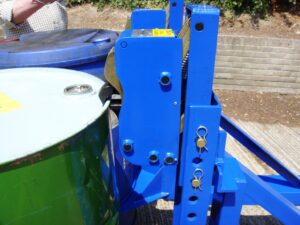
Weight. At around 450 kilograms, a full drum of raw honey is a substantial load. There is no margin for an attachment with loose tolerances or underspecified materials. The rim gripper – sometimes called a parrot beak gripper from the shape of its jaws – must engage cleanly onto the drum rim and hold under load without flex or slippage.
Hygiene. Honey is a food product, and the receiving and handling environment is subject to food safety standards. Any contamination risk from the handling equipment has to be managed. Hydraulic drum handling attachments introduce a specific risk here: hydraulic fluid leaks. In a honey production environment, contamination from hydraulic oil would be a serious food safety incident. Grab-O-Matic attachments are entirely mechanical – no hydraulic fluid, no hoses, no seals to fail. This is not incidental to the food industry application; it is one of the reasons mechanical attachments are the appropriate choice in food production settings.
Stickiness. Honey is one of the stickiest substances handled in bulk food production. Spillages – from damaged drum seams, loose bungs or mishandled loads – are extraordinarily difficult to clean up and attract contamination. Getting the drum handling right the first time, every time, is the only practical approach.
Volume and repetition. In a high-throughput honey operation, the forklift handling of drums is not taking occasional lifts, it is running continuously across a shift. An attachment that works well for light-duty use can wear and loosen under this kind of sustained load, with tolerances opening up in the jaw mechanism and grip becoming less reliable.
What makes Grab-O-Matic suited to this application
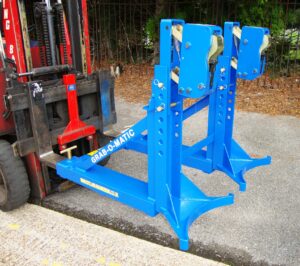
Grab-O-Matic attachments are precision-engineered with close tolerances throughout the gripping mechanism. The jaws are hardened and drop-forged grain flow – a manufacturing process that aligns the grain structure of the steel along the shape of the jaw, making it significantly stronger and more fatigue-resistant than cast or machined alternatives. Under sustained, repeated loading, a hardened drop-forged jaw maintains its geometry and grip characteristics far longer than a lower quality fabricated or cast component.
The framework on a Grab-O-Matic is manufactured from thicker, more robust materials than most alternative products. The structural members are designed for duty, not for minimum cost at manufacture. This matters in operations running hundreds of lifts a day.
Because the attachments are mechanical and require no hydraulic or electrical connection to the forklift, they are virtually maintenance-free in normal use. Occasional lubrication is all that is required between 6 monthly or annual inspections. In a food production environment where equipment downtime has a direct impact on output, an attachment that does not need regular hydraulic maintenance is a practical advantage.
Every Grab-O-Matic leaves our Hampshire facility fully inspected and tested, with a Safe Working Load certificate. The 12-month warranty is backed by an extensive record of minimal returns due to defects – which reflects both the quality of materials used and the 100% inspection policy before dispatch.
The practical result of building to this standard is a service life that is measured in decades rather than years. Units built by St Clare Engineering are still in active daily use 30 years after manufacture. For a honey operation running hundreds of drum movements a day, an attachment that lasts a generation represents a very different total cost of ownership from a lower cost alternative that needs replacing every few months or years.
When units do require attention, St Clare Engineering’s servicing and spares operation supports the full life of the equipment. As the manufacturer, we hold a complete stock of parts and can carry out inspections, repairs and testing with fast turnaround – collecting the unit from your premises, completing a full service to LOLER standards, and returning it with a new test certificate. Loan units are available if required to cover the service period, keeping operations running. For UK customers, warranty is extended by a further 6/12 months each time a unit is returned for its annual service inspection. This is the kind of aftersales support that matters most in operations where equipment downtime has a direct impact on output.
From small apiaries to large-scale producers – and across the world
Not every honey operation runs at the scale of Rowse or Hilltop. Smaller producers like Littleover Apiaries handle a lower volume of drums but face the same fundamental handling challenge: raw honey is heavy, it crystallises solid, it is a food product requiring hygiene-conscious handling, and the cost of a spillage or equipment failure is significant relative to the scale of the operation.
For smaller operations, the low-maintenance design and long service life of Grab-O-Matic attachments represent good value over time. An attachment that lasts for years without unplanned repairs or replacement is a different proposition from a lower initial cost alternative that may wear out under sustained use.
Because raw honey is a global commodity – sourced from apiaries across New Zealand, South America, Eastern Europe and beyond – honey packing and processing operations exist worldwide. St Clare Engineering exports Grab-O-Matic drum handling attachments to customers in over 35 countries, and the same handling challenges that apply in a UK honey facility apply equally to operations in other markets. Our international export guide covers how overseas buyers can source equipment directly from our Hampshire facility, with full certification documentation as standard.
A specialised application worth getting right
Honey is one of those industries where the drum handling problem looks straightforward until it is not. The weight of a 450-kilogram solid drum, handled hundreds of times a day in a hygiene-controlled food environment, is not a standard warehouse duty cycle. It requires an attachment built to handle the load consistently over a long service life, without presenting contamination risks to the product.
Grab-O-Matic drum handling attachments have been in daily use in the honey industry for many years. If you are handling honey in bulk, contact our team to discuss the right specification for your operation.
FAQs
What size drums is raw honey supplied in? Raw bulk honey is typically supplied in standard 200-litre steel drums. These are the same tighthead drum format used across many food and chemical industries, which means a standard rim gripper – also called a parrot beak gripper – is the appropriate attachment for handling them.
How heavy is a drum of raw honey? A 200-litre drum of raw honey weighs approximately 450 kilograms. This is significantly heavier than most other bulk food commodities handled in the same drum format, and considerably heavier than the equivalent volume of water. Raw honey crystallises into a solid state in transit, which contributes to the weight and density of the loaded drum.
What forklift attachment is used for honey drums? A rim gripper (parrot beak gripper) is the standard attachment for 200-litre honey drums. The jaws engage automatically onto the top rim of the drum as the forklift approaches, gripping as the drum is raised by the drum’s own weight. No hydraulic or electrical connection is required. For operations also handling pallets, the Grab-O-Matic Quick Release System allows fast changeover between drum handling and pallet work without the operator leaving the cab.
Why are lower quality rim grippers unsuitable for high-volume honey operations? In high-throughput operations handling hundreds of drums a day, lower quality attachments wear quickly. Loose tolerances in the gripping jaw mechanism, reduce grip reliability, and underspecified materials deform under sustained heavy loading. Grab-O-Matic rim grippers use hardened, drop-forged grain flow gripping jaws and are built to close tolerances specifically to maintain consistent performance under continuous use.
Are Grab-O-Matic drum handlers suitable for food production environments? Yes. Because Grab-O-Matic attachments are entirely mechanical – no hydraulic fluid, no hoses, no seals – there is no risk of hydraulic contamination in the handling area. This makes them the appropriate choice for food production environments where contamination from equipment fluids would present a food safety risk.
All standard Grab-O-Matics are also available in Stainless Steel for use in areas where hygiene is paramount.
Can Grab-O-Matic attachments be supplied to honey producers outside the UK? Yes. St Clare Engineering exports to customers in over 35 countries. All units are supplied with full certification documentation including CE and UKCA certificates, ISO 9001:2015 quality certification, proof-load test certificates and Safe Working Load markings. See our international buyer guide for details on the export process.
About the author
Andy Bow
Managing Director, St Clare Engineering
Andy Bow is Managing Director of St Clare Engineering, the sole worldwide manufacturer of the Grab-O-Matic range of drum handling forklift attachments. St Clare Engineering has been designing and building drum handling equipment at its Hampshire facility since 1959.
