
29th January, 2026
Safe drum handling: how to move and lift 200-litre drums safely

Why safe drum handling matters in industrial environments
St Clare Engineering designs and supplies drum-handling forklift attachments for industrial environments. This guide explains how to handle 200-litre drums safely, why manual handling presents significant risks, and how mechanical drum-handling equipment supports safer, more efficient operations.
Why safe drum handling matters in industrial environments 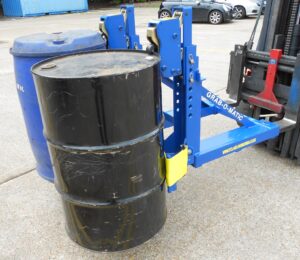
Drum handling is a common task across manufacturing, logistics, chemical processing and energy sectors, yet it remains a frequent cause of workplace injuries, spills and equipment damage. A standard 200-litre drum can weigh well over 200 kg when full, and its cylindrical shape makes it difficult to control without appropriate equipment.
Authoritative safety guidance highlights the scale of the risk. According to the Ultimate HSE Guide to chemical drum handling and storage:
“Industrial 205-litre drums and barrels can weigh up to 350 kg when full, well in excess of UK guidance on manual handling limits.” HSE Store
Poor drum handling can lead to musculoskeletal injuries, loss of containment and operational downtime. For this reason, safe drum handling is a core part of risk management rather than simply an efficiency consideration.
Manual vs mechanical drum handling
Manual handling may be used for limited movement of empty drums in controlled circumstances, but it is not suitable for full 200-litre drums. The weight and instability of a full drum make manual movement unsafe in most industrial environments.
The Health & Safety Executive (HSE) advises that mechanical assistance reduces both effort and risk:
“A drum trolley for moving oil drums not only reduces effort, but keeps the load secure.”
Health & Safety Executive
As handling frequency increases, or where drums are stored at height or moved across busy sites, mechanical drum-handling equipment becomes essential for maintaining control and reducing injury risk.
Types of drum-handling equipment
The safest handling method depends on how often drums are moved, the distances involved and the nature of the contents.
Manual aids
Drum dollies, skates and trolleys may be suitable for very short moves or infrequent handling of empty or lightly loaded drums. These solutions rely heavily on operator control and are not appropriate for heavier or hazardous loads.
Mechanical handling equipment
Mechanical solutions provide greater consistency and safety for most industrial applications. Forklift trucks fitted with drum-handling attachments allow drums to be lifted, transported and positioned with precision, reducing manual intervention and improving stability throughout the move.
How forklift drum-handling attachments improve safety
Forklift-mounted drum-handling attachments are designed to securely grip drums without damaging the container. When correctly specified, they allow drums to be lifted from floor level or pallets, transported safely across site and placed accurately into storage or processing areas.
This approach:
- Minimises manual handling
- Improves load stability
- Reduces spill risk
- Keeps operators at a safe distance
Attachments are available for different drum materials and handling requirements, including lifting only or lifting with controlled rotation.
Reducing changeover time with a quick release system
Forklifts are often required to perform multiple tasks throughout the working day. Manually fitting and removing attachments can be time-consuming and introduces the risk of incorrect installation as well as potential safety risks for the driver.
St Clare Engineering’s Quick Release System for forklift attachments allows drum-handling attachments to be mounted and removed quickly and securely, reducing downtime and helping ensure attachments are correctly fitted before use. This supports safer operation while improving overall efficiency.
Handling multiple drums
For high-volume operations, multi-drum handling attachments allow more than one drum to be lifted at a time. This improves productivity while maintaining secure control of each drum during movement.
Handling different drum materials and contents
Drum material, contents and operating environment all influence the safest handling approach.
Steel, plastic and fibre drums
Steel drums are durable but heavy, while plastic and fibre drums may require gentler handling to avoid deformation. Using equipment designed for the specific drum material helps maintain grip security and prevent damage.
Handling hazardous drums
Drums containing chemicals, oils or flammable substances require additional care. Equipment should be selected to minimise damage to the drum and reduce ignition or spill risk.
In hazardous environments, stainless-steel drum handlers and ATEX-rated drum-handling equipment is commonly used to support safe operation and compliance.
Barrels and casks
Some operations use barrels or casks rather than standard industrial drums, particularly in food and beverage production such as wine or whisky. These containers require barrel and cask handling equipment shaped to support the barrel profile and protect surface finishes during lifting and transport.
Lifting, moving and pouring drums safely
Safe drum handling extends beyond transport. Many processes require drums to be lifted, tilted or emptied as part of production or transfer operations.
Drum rotators for controlled pouring keep the drum securely clamped throughout the tilting movement. This reduces the risk of sudden shifts in weight, splashing or loss of control, helping protect operators and surrounding equipment.
Choosing the right drum-handling solution
Selecting the appropriate drum-handling equipment starts with understanding how drums are used on site. Key considerations include:
- Drum weight when full
- Frequency of handling
- Storage layout and lift height
- Whether drums need to be rotated or poured
- Environmental conditions such as temperature or exposure
For short-term projects, shutdowns or occasional handling, drum handling equipment hire can provide access to the correct solution without long-term commitment, while still maintaining safe working practices.
Maintenance, servicing and reliability
Drum-handling attachments are safety-critical equipment and should be inspected and maintained regularly. Routine checks help identify wear, maintain grip performance and extend service life. Find out more about St Clare Engineering maintenance and inspection of drum-handling equipment here.
Planned servicing reduces the risk of unexpected downtime and supports consistent performance in demanding industrial environments.
Drum handling in extreme climates and global operations
Some sites operate in challenging conditions, including extreme cold, heat or outdoor exposure. Equipment must be suitable for these environments to maintain reliability and operator safety. St Clare Engineering offers drum handling equipment suitable for extreme climates.
For organisations operating internationally, drum-handling solutions must also consider transport, export requirements and compatibility with local regulations. Experience supplying equipment worldwide helps ensure reliable performance across regions. Find out more about exporting drum-handling equipment worldwide
Safe drum handling: next steps
Handling 200-litre drums safely requires care and consideration. Variations in drum weight, stability and contents mean that manual handling presents a consistent risk in industrial environments. Using mechanical drum-handling equipment helps reduce injuries, prevent spills and maintain control throughout lifting, transport and pouring operations.
Forklift-mounted drum-handling attachments are widely used where drums are handled regularly, offering a practical way to minimise manual handling while improving consistency and efficiency. Selecting the right attachment depends on factors such as drum type, handling frequency, environment and whether drums need to be rotated or poured.
If you would like advice on selecting drum-handling equipment for your operation — including attachment type, quick release options, hire or suitability for hazardous environments — St Clare Engineering can help you assess the safest and most practical approach.
Contact the St Clare Engineering team to discuss your drum-handling requirements or explore suitable equipment options.
Frequently asked questions about drum handling
How heavy is a full 200-litre drum?
A full 200-litre drum typically weighs between 180 kg and over 300 kg, depending on the material inside. This weight places it beyond safe manual handling limits in most industrial environments.
Is it safe to move a 200-litre drum manually?
Moving a full 200-litre drum manually is not considered safe due to its weight, shape and instability. Manual handling significantly increases the risk of injury, loss of control and spills.
Can a forklift lift a drum safely?
A forklift can lift a drum safely when it is fitted with a drum-handling attachment designed to securely grip and support the drum throughout the lift and movement.
What equipment is used to handle oil drums?
Oil drums are commonly handled using mechanical equipment such as forklift-mounted drum-handling attachments, which provide secure lifting and controlled movement while reducing spill risk.
Do hazardous drums require special handling equipment?
Drums containing hazardous or flammable substances typically require specialised handling equipment to reduce the risk of damage, spills or ignition and to support safe operation.
What is the safest way to move drums regularly?
For regular drum handling, mechanical solutions such as forklift-mounted drum-handling attachments provide the safest and most consistent approach by reducing manual handling and improving load control.
